Key Takeaways
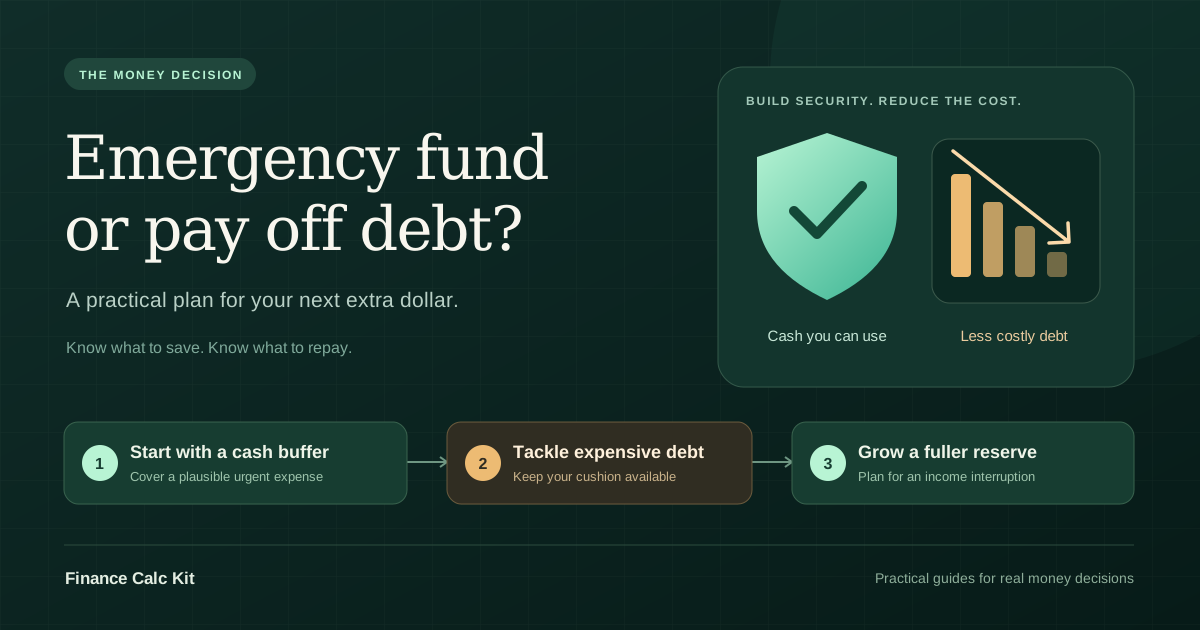
- Keep the basics covered. Pay essential bills and required debt payments before allocating extra money.
- Build a starter cash buffer. Choose an amount that could cover a plausible urgent expense without borrowing again.
- Then balance interest cost against income risk. Expensive debt favors faster repayment; unstable income can justify more cash first.
- Recalculate as life changes. A paid-off loan can lower your emergency fund target and increase what you can save each month.
You have $600 left after this month's spending. Should it go into savings or toward your credit card? Paying debt reduces interest, but leaving yourself without cash can send the next repair straight back onto the card. A workable plan needs to handle both.
This guide offers a sequence you can adapt, followed by a complete monthly budget example. Dollar amounts are illustrative USD, and rates are assumptions rather than current offers. The budgeting approach works in other currencies; tax and deposit insurance details below refer specifically to the United States.
A practical order for your next extra dollar
Use your current situation to choose the next step. This is our planning framework, based on the consumer guidance cited throughout, rather than a universal rule from a regulator.
| Your situation | Your next priority |
|---|---|
| Essential bills or minimum payments are unaffordable | Stabilize cash flow and contact providers about payment options before making extra repayments. |
| Bills are current, but emergency savings are near zero | Build a starter emergency buffer while maintaining required payments. |
| A buffer is in place and expensive debt remains | Direct extra money toward the costliest debt, keeping your buffer available. |
| Income could stop or fall soon | Consider building a larger reserve before accelerating debt payments. |
| Expensive debt is cleared | Redirect freed payments into a fuller emergency fund, then reassess other goals. |
If you cannot cover everything, start with consequences
An extra credit card payment should not leave rent or essential medicine unpaid. The CFPB's bill-prioritization toolkit asks readers to protect housing, income, insurance, and court-ordered obligations. Contact a creditor when a payment is unaffordable instead of assuming silence will help. A nonprofit credit counselor may help you assess options. If there is no monthly surplus, the immediate task is closing that gap, not selecting a savings percentage.
Separate emergencies from bills you can predict
Keep three jobs for cash distinct: money for bills due before payday, money for known future expenses, and money for genuine surprises. Mixing them makes your emergency balance look healthier than it is. A $1,000 account is not a $1,000 reserve if $800 is already committed to next week's rent.
Annual insurance premiums, school supplies, and holiday spending belong in a planned expenses fund, often called a sinking fund. An unexpected urgent repair belongs in emergency savings. The Financial Consumer Agency of Canada makes this distinction. For example, spreading a known $1,200 annual bill over a year means setting aside $100 each month. Do not count that earmarked money toward your emergency target.
Set a starter buffer you can actually reach
A starter fund handles an urgent bill while you work on debt; a full reserve is meant to support you through a longer income interruption. Those are different milestones. The CFPB recommends considering your own past unexpected expenses when choosing an amount. It does not prescribe one dollar target for every household.
Write down two or three plausible shocks, such as an essential car repair or an insurance deductible you could have to pay. Select an initial cash target that addresses a realistic near-term risk. A household dependent on one aging car may need a different cushion from someone who walks to work. Increase it when risks could overlap.
This simple estimate assumes a positive monthly contribution, no withdrawals, and no interest. Round up to the next whole monthly deposit.
In our example, a $1,600 urgent repair is the selected starter target. With $400 already saved and $600 available monthly, two deposits fill the $1,200 gap. That is an example of a household-specific target, not a claim that $1,600 is enough for everyone.
Calculate a fuller fund from essential expenses
For a longer disruption, estimate what you would still need to pay each month. The Canadian consumer agency suggests building toward three to six months of regular expenses; the FDIC describes at least six months of living expenses as a common expert recommendation. These are planning benchmarks. Choose a period that reflects how long your household might need support, and build toward it in stages.
| Expense | Monthly amount |
|---|---|
| Housing | $1,400 |
| Utilities and basic phone service | $200 |
| Groceries | $400 |
| Essential transport | $250 |
| Healthcare and insurance | $200 |
| Credit card minimum payment | $200 |
| Other essential obligations | $150 |
| Total essential expenses | $2,800 |
Include required payments and the monthly equivalent of essential annual bills in the relevant categories. Estimate changes during unemployment too, such as higher health insurance costs or reduced commuting. Exclude optional extra debt payments and spending you could realistically pause. Use the emergency fund calculator in itemized mode to build your own estimate.
A single income, dependents, specialized work, or irregular freelance receipts may justify a longer runway. Two incomes help only to the extent that both are reliable; jobs at the same employer can disappear together. Do not subtract an anticipated benefit or family contribution from your target until you understand its availability and timing. These are reasons to adjust the estimate, not guarantees about how long a job search will take.
Why expensive debt usually comes next
Once you have a usable cash cushion, compare the cost of keeping debt with what extra savings might earn. SEC Investor.gov emphasizes eliminating high-interest debt because reliably matching those interest costs through investing is difficult. This does not make every loan equally urgent: ordinary credit card debt needs a different analysis from a low-rate loan with special protections or tax treatment.
Suppose your card charges 24% APR and a savings account pays a hypothetical 4% APY. On an extra $1,000, compare a year of savings interest with an annual card-interest estimate that ignores compounding:
The card estimate assumes that paying down principal keeps the balance $1,000 lower throughout the year at an unchanged APR. Real savings depend on payment timing, future charges, and daily interest calculations. The savings figure assumes the deposit stays untouched and the APY does not change for a year.
A year on an extra $1,000
Both bars cover one full year on the same $1,000. The card estimate ignores compounding; the savings rate is assumed to stay unchanged.
- Card interest avoided24% APR, approximate
- $240
- Savings interest earned4% APY, before tax
- $40
Paying debt reduces a cost. Savings interest adds cash to your account. These figures compare the amounts, not how much emergency cash you would still have available.
Taxes can widen the difference. The IRS generally treats bank-account interest as taxable income. If all that interest faced a hypothetical 22% federal marginal rate, with no state tax, the $40 would leave $31.20 after federal tax:
This illustrates why stockpiling cash far beyond your chosen buffer can be costly while expensive debt remains. However, money paid to a lender is no longer available for an emergency. Do not treat a credit limit as a substitute for cash, or describe avoided interest as a spendable investment return.
Choose a repayment method you will maintain
The debt avalanche directs extra payments to the highest interest rate while you maintain other minimums. With comparable terms and the same payment budget, this generally reduces interest most efficiently. The debt snowball starts with the smallest balance to produce earlier account closures, potentially at a higher interest cost. The CFPB explains both methods and their trade-offs. Compare them using your balances in the debt payoff calculator.
A worked plan for a $4,000 monthly income
Consider one household with the $2,800 essential budget above, including a $200 credit card minimum. Take-home pay is $4,000, and flexible spending is $600. That leaves $600 for the current priority. There is $400 in uncommitted emergency savings. There is one card debt, and no other debt payments in this example.
- Reach the $1,600 starter target. Save $600 for two months, while paying the required card payment from the essential budget. This assumes no emergency withdrawals.
- Switch the surplus to the card. Keep $1,600 available and pay an extra $600 toward debt. Together with the budgeted $200, the planned total card payment is $800. If the required minimum changes, recalculate the split within your available budget.
- Rebuild the buffer if you use it. If an urgent $900 expense reduces savings to $700, temporarily direct surplus back to cash. Return to faster debt repayment after restoring your chosen cushion.
- Redirect the entire payment after payoff. Once the card is cleared, the previous $600 surplus and freed $200 payment can provide $800 a month for savings, assuming other costs stay unchanged.
Notice that essential expenses now fall to $2,600 because the card payment disappears. The three-month target becomes $7,800 and the six-month target becomes $15,600. Starting with the intact $1,600 buffer, the following timelines count full monthly deposits and ignore savings interest:
Emergency savings after card payoff
Start with $1,600 and deposit $800 each month. Steps show full monthly deposits. Dashed lines mark the three- and six-month reserve targets.
Monthly deposits since card payoff
- 3-month reserve
- 8 deposits
- $7,800 target · $8,000 saved
- 6-month reserve
- 18 deposits
- $15,600 target · $16,000 saved
No interest or withdrawals. This starts after the debt is cleared and uses full $800 deposits; the final deposit can be smaller if you stop exactly at your target.
| Coverage | Target | Gap from $1,600 | At $800 monthly |
|---|---|---|---|
| 3 months | $7,800 | $6,200 | 8 deposits |
| 6 months | $15,600 | $14,000 | 18 deposits |
Both timelines start at card payoff, not today. They exclude the time needed to repay the card, which depends on its balance, rate, fees, and future charges. The last deposit can be reduced to the remaining gap. Build your own spending baseline with the budget calculator.
When saving more cash first makes sense
If a contract ends next month, you face a likely layoff, or a household member cannot work, liquidity may matter more than faster repayment. Pause and estimate the cash needed until the next dependable income arrives. Continue required payments, but reconsider extra repayments that would leave that interval unfunded. A larger reserve can also be sensible when your remaining debt is inexpensive and manageable.
There is no automatic 50/50 split that solves these cases. Write a specific rule, such as keeping one month of essential costs before resuming extra payments, then review it when work becomes stable. This is a judgment about your risks and available cash, not an assumption that one month is adequate for every household.
Where to keep your emergency fund
Look for accessible savings with low fees and straightforward withdrawal rules. Check transfer times before you need the money. A higher advertised yield is less useful if reaching your cash causes delays or penalties. Keep the reserve identifiable so ordinary spending does not quietly use it up.
In the U.S., FDIC coverage generally insures eligible bank deposits up to $250,000 per depositor, per insured bank, per ownership category. Savings accounts and money market deposit accounts can be covered. Money market mutual funds, stocks, and crypto are not FDIC-insured deposits. A market investment can also lose value when you need to sell. Verify the institution and account type instead of assuming every product with “savings” in its marketing has the same protection.
Your next 30 minutes
- List essential expenses, debt minimums, and the dates bills leave your account.
- Separate already-committed cash from money available for emergencies.
- Pick a starter target based on a plausible urgent cost.
- Assign your actual surplus to that target or to the chosen debt.
- Schedule a review after payday. If you automate transfers, leave enough for upcoming bills to avoid overdrafts.
Frequently asked questions
Should I use all my savings to pay off credit card debt?
Is a $1,000 starter emergency fund enough?
Should my target be based on salary or expenses?
What if I can save only a small amount each month?
Does a 0% promotional credit card change the order?
How often should I review my emergency fund?
Sources and methodology
Primary sources checked on November 4, 2026. The priority sequence and household examples are our educational synthesis, not a regulator's prescribed allocation. Savings milestones use whole monthly deposits with no interest or withdrawals. Rates, income, spending, and the tax bracket are illustrative assumptions.
- CFPB: An essential guide to building an emergency fund
- CFPB: Your Money, Your Goals, prioritizing bills
- Financial Consumer Agency of Canada: Setting up an emergency fund
- FDIC: Saving for the Unexpected and Your Future
- SEC Investor.gov: Pay Off Credit Cards or Other High Interest Debt
- CFPB: How to reduce your debt
- FDIC: Deposit Insurance
- IRS: Topic no. 403, Interest received
- CFPB: How deferred-interest credit card offers work