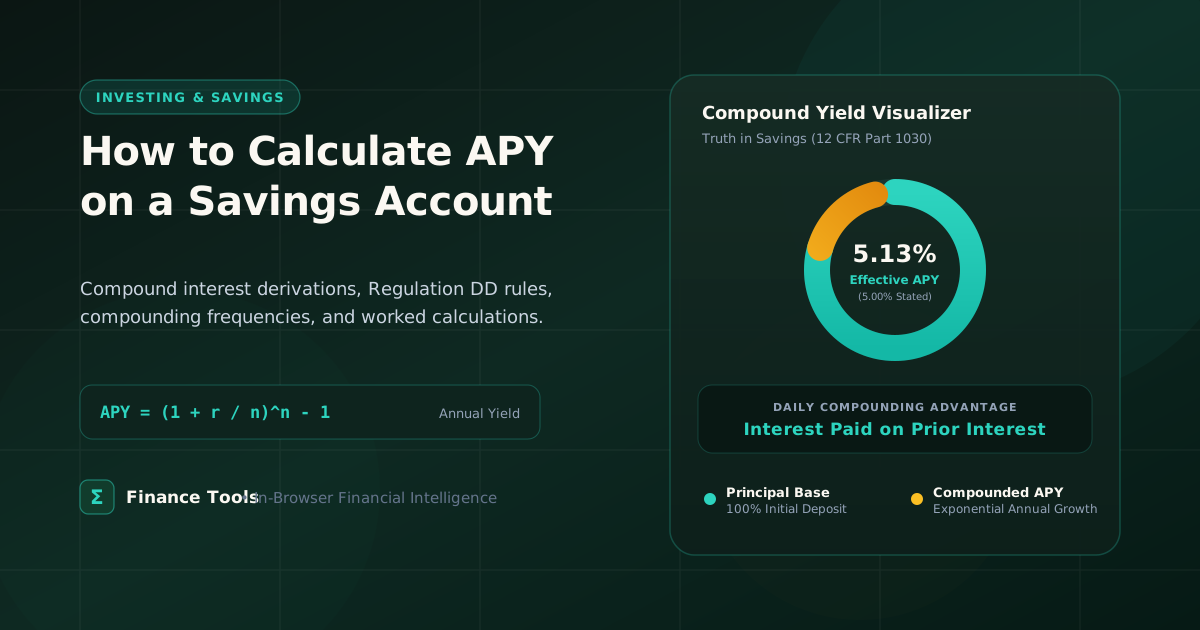
- Compound Growth Reflected: Annual Percentage Yield (APY) reflects the total interest earned over a one-year period, taking into account compounding interest that builds on previous interest payments.
- APR vs. APY Distinction: Annual Percentage Rate (APR) represents the simple, non-compounded annual interest rate. APY is always greater than or equal to APR because it accounts for compounding frequency.
- Compounding Frequency Matters: The more frequently your bank compounds interest (daily vs. monthly vs. annually), the higher the resulting APY from the exact same nominal interest rate.
- Federal Regulation DD Standards: In the United States, 12 CFR Part 1030 mandates that financial institutions disclose standardized APY formulas for advertised rates and periodic statement APY Earned (APYE) based on average daily balances.
What is Annual Percentage Yield (APY)?
Annual Percentage Yield (APY) is the standardized, effective annualized rate of return on an interest-bearing deposit account. Unlike simple nominal interest rates, APY accounts for the compounding effect, where interest accrued during one cycle is added to your account balance and begins generating its own interest in subsequent cycles.
Whether you are comparing high-yield savings accounts (HYSAs), certificates of deposit (CDs), or cash management accounts, APY provides the true apple-to-apples metric to evaluate how much money your savings will actually produce over a twelve-month horizon. To calculate your personalized annual yields and future balances instantly, use our interactive APY calculator or convert between nominal rates and yields with the APR to APY calculator.
The Standard APY Formula
When you know the nominal annual interest rate and the number of compounding periods per year , you can calculate the effective APY using the classic compounding formula:
Where = Stated Nominal Annual Interest Rate (expressed as a decimal, e.g., 0.05 for 5.00%), and = Number of Compounding Periods per Year ( for daily, for monthly, for quarterly).
To express the result as a percentage, multiply by 100:
Mathematical Derivation of the APY Formula
Why does this equation reflect true annual growth? The mathematical foundation originates from compound interest accumulation over time.
Suppose you deposit an initial principal into an account with nominal annual rate compounded times per year. In each individual period, the account earns periodic interest at the rate .
- End of Period 1: Balance
- End of Period 2: Balance
- End of Period (Full 1 Year): Final Balance
The effective annual yield measures the net dollar growth relative to the original principal deposited:
In the theoretical limit where compounding happens continuously every instant (), Euler's constant defines the mathematical upper bound:
Truth in Savings Act: Regulation DD Calculation Rules
In the United States, the Consumer Financial Protection Bureau (CFPB) oversees Regulation DD (12 CFR Part 1030), enacted under the Truth in Savings Act. Regulation DD protects savers by standardizing how banks calculate and advertise deposit rates, eliminating misleading promotional figures.
Regulation DD establishes two distinct statutory APY calculations:
1. Standard Account APY (Offered / Advertised Rate)
For standard savings accounts without a fixed maturity, banks must calculate the disclosed APY assuming funds remain on deposit for an exact 365-day term with no intermediate deposits or withdrawals:
2. Statement APY Earned (APYE) on Periodic Statements
On your monthly bank statement, the bank must display the Annual Percentage Yield Earned (APYE). This reflects the actual dollar interest paid relative to your Average Daily Balance across that specific statement cycle:
Where Average Daily Balance is the sum of account principal balances at the end of each day divided by the total number of days in the billing statement cycle.
How Compounding Frequency Impacts Your Yield
The frequency at which interest is calculated and reinvested directly affects your total annual earnings. Consider a $10,000 deposit earning a stated nominal rate of 5.00% APR across different compounding schedules:
| Compounding Frequency | Periods per Year () | Effective APY | 1-Year Interest on $10,000 | 5-Year Balance |
|---|---|---|---|---|
| Annually | 1 | 5.0000% | $500.00 | $12,762.82 |
| Semiannually | 2 | 5.0625% | $506.25 | $12,800.85 |
| Quarterly | 4 | 5.0945% | $509.45 | $12,820.37 |
| Monthly | 12 | 5.1162% | $511.62 | $12,833.59 |
| Daily (Most HYSAs) | 365 | 5.1267% | $512.67 | $12,840.03 |
| Continuous | 5.1271% | $512.71 | $12,840.25 |
Most high-yield online savings accounts compound interest daily but credit the accumulated interest to your account balance monthly on the final calendar day or statement closing date. Daily compounding ensures every dollar deposited starts earning interest the next morning.
Worked Numerical Examples
Let us examine three real-world calculations demonstrating how to compute APY, analyze bank statements, and project multi-year growth.
Example 1: Converting an Advertised 4.75% Daily Compounding Rate to APY
Suppose an online bank advertises a nominal savings rate of compounded daily () on a $15,000 deposit.
Step 1: Calculate the daily periodic interest rate:
Step 2: Add 1 and raise to the 365th power:
Step 3: Subtract 1 and convert to a percentage:
Annual Interest Earned on $15,000:
Example 2: Calculating APY Earned (APYE) from a Monthly Bank Statement
You receive a monthly bank statement for the month of March (31 days). The statement shows:
- Average Daily Balance: $20,000.00
- Interest Paid for Statement Period: $78.50
- Days in Billing Cycle: 31 days
Step 1: Compute the interest-to-balance ratio:
Step 2: Calculate the annualization exponent:
Step 3: Solve for Statement APY Earned:
Example 3: Projecting Multi-Year Compounded Savings Growth
To project future wealth accumulation across multiple years, use the compounded future value formula based directly on APY:
For an initial deposit placed in an account earning an average over years:
Total interest accumulated over 5 years is $6,154.55, representing a 24.62% cumulative gain on your original savings.
APR vs. APY: Why the Difference Matters
A common source of confusion in personal finance is the difference between APR and APY. Financial institutions strategically highlight one or the other depending on whether you are borrowing or saving:
| Feature | APR (Annual Percentage Rate) | APY (Annual Percentage Yield) |
|---|---|---|
| Core Definition | Simple annual rate without compounding. | Effective annual rate including compound interest. |
| Governing Regulation | Truth in Lending Act (Regulation Z). | Truth in Savings Act (Regulation DD). |
| Common Products | Mortgages, auto loans, personal loans, credit cards. | Savings accounts, money market accounts, CDs. |
| Relative Size | Always lower than or equal to APY for the same terms. | Always higher than or equal to APR for the same terms. |
| Marketing Rule of Thumb | Lenders quote APR because it makes debt look cheaper. | Banks quote APY because it makes savings look higher. |
To convert any loan or debt APR to its true effective borrowing cost, explore our APY to APR calculator.
High-Yield Savings Accounts vs. Traditional Accounts vs. CDs
The APY offered across different deposit structures varies widely. Understanding how each account type handles rates and liquidity helps you optimize cash reserves for emergency funds and short-term goals:
| Account Type | Typical APY Range | Rate Flexibility | Liquidity & Access | 5-Yr Gain on $20,000 |
|---|---|---|---|---|
| Traditional Brick-and-Mortar | 0.01% - 0.25% | Variable | Immediate (ATM & branch) | $10.00 - $251.50 |
| High-Yield Savings Account (HYSA) | 4.00% - 5.25% | Variable (tracks Fed rate) | 1-3 business day ACH transfer | $4,333.00 - $5,831.00 |
| Certificate of Deposit (CD) | 4.25% - 5.50% | Fixed for term duration | Locked (early withdrawal penalty) | $4,628.00 - $6,139.00 |
| Money Market Account (MMA) | 3.75% - 5.00% | Variable | Check-writing & debit card | $4,042.00 - $5,526.00 |
Leaving $20,000 in a traditional brick-and-mortar account paying 0.01% yields just $10 over five years. Placing those same funds into an online HYSA paying 4.50% APY generates more than $4,900 in compounding gains. If you want to lock in guaranteed fixed rates for a set duration, check terms with our CD calculator.
Taxes, Inflation, and Calculating Real Purchasing Power
Nominal APY tells only part of the story. Two economic factors affect your true financial return: income taxes and purchasing power inflation.
1. Federal and State Income Taxation
In the United States, interest income is taxed as ordinary income at your marginal tax bracket (reported annually on IRS Form 1099-INT for amounts of $10 or more). Your after-tax yield is calculated as:
For example, if you earn 5.00% APY and your combined federal and state marginal tax bracket is 28%, your net after-tax yield is .
2. Inflation-Adjusted Real APY (Fisher Equation)
Inflation erodes the future purchasing power of your money. To determine whether your cash balance is growing in real economic terms, use the exact Fisher relationship:
If your savings account delivers 4.50% APY during a year when headline inflation is 3.00%, your true purchasing power increase is:
Strategic Rules to Maximize Your Savings Growth
Ensure any banking institution or fintech partner holds active FDIC (for banks) or NCUA (for credit unions) insurance. Standard coverage protects deposits up to $250,000 per depositor, per insured institution, for each account ownership category.
Some institutions advertise high headline APYs that only apply to the first $5,000 of your balance, dropping to 0.10% for balances exceeding that cap. Always read account disclosures to ensure your entire balance earns the promotional APY.
Setting up automatic direct deposits from your paycheck directly into a high-yield account accelerates compound growth by consistently feeding new principal into the compounding engine every pay period.
Frequently asked questions
Can the APY on my savings account change after I open it?
Why is interest compounded daily but only paid once a month?
Why is APY always higher than the nominal interest rate?
How are savings account APY earnings taxed?
Why does the APY Earned on my monthly statement differ from the advertised APY?
Does daily compounding make a significant difference over monthly compounding?
Resources and references
The formulas and methods in this calculator were checked against these independent sources.