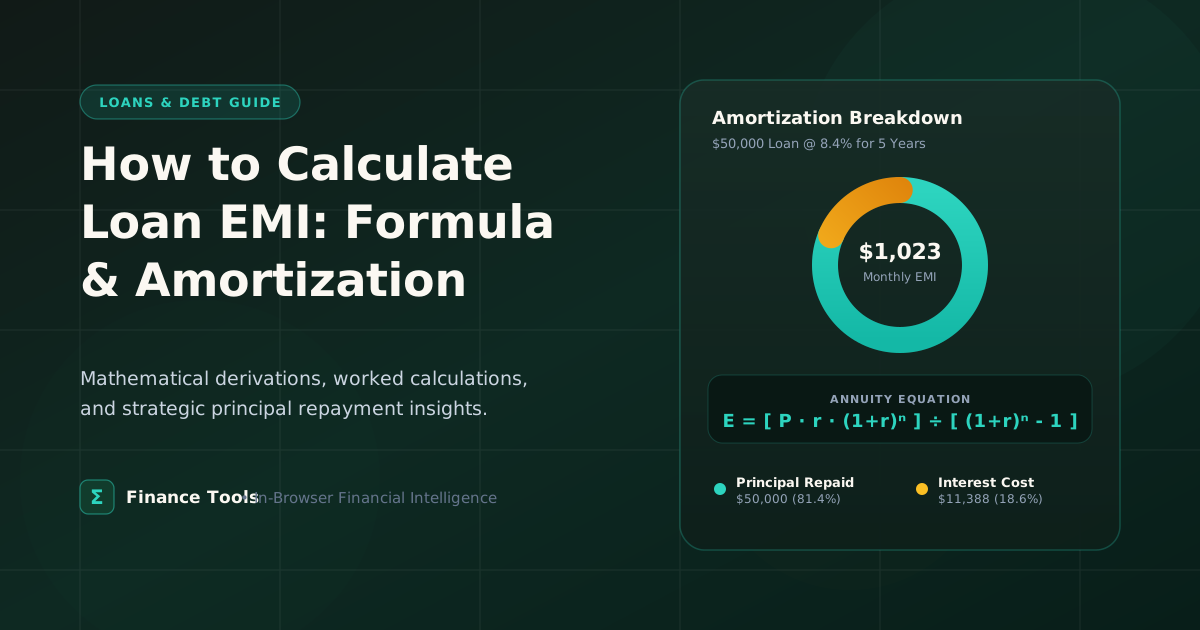
- Constant Payment, Shifting Balance: While your total EMI remains unchanged each month, the interest portion shrinks over time while the principal repayment portion grows.
- The Power of Prepayments: Extra principal payments made during the first third of your loan tenure deliver the highest interest savings because early payments reduce the base compounding interest.
- Tenure vs. Monthly Cost Tradeoff: Extending loan tenure lowers your monthly payment obligation but dramatically increases the cumulative interest paid over the life of the loan.
What is an Equated Monthly Installment (EMI)?
An Equated Monthly Installment (EMI) is a fixed payment amount made by a borrower to a lender at a specified calendar date each month. EMIs are designed to fully pay off both interest and principal over a set loan term, reducing the outstanding balance to exactly zero on the final payment date.
Whether you are evaluating a personal loan, an auto loan, or a 30-year fixed home mortgage, understanding how the math operates empowers you to choose optimal repayment terms, minimize lifetime interest expenses, and negotiate with financial institutions from a position of clarity. To experiment with your specific loan figures instantly, you can use our interactive EMI calculator or examine detailed period breakdowns with the amortization calculator.
The Standard Loan EMI Formula
Banks and lending institutions worldwide use the standard amortization annuity formula to compute monthly installments for fixed-rate loans:
Where E = Equated Monthly Installment, P = Principal Loan Amount, r = Monthly Interest Rate (Annual Rate ÷ 12 ÷ 100), and n = Total Number of Monthly Installments (Tenure in Years × 12).
Step-by-Step Mathematical Derivation
Why does this formula work? The mathematical premise rests on the time value of money. The present value of the loan principal must equal the sum of the discounted present values of all future monthly installments :
Factoring out the installment , the right-hand side is a finite geometric progression series with initial term and common ratio :
Solving for by isolating it on the left-hand side gives us the exact EMI equation used across the banking sector:
Worked Numerical Example: Calculating a $50,000 Loan
Let us walk through a complete real-world calculation step by step. Suppose you take out a loan with the following parameters:
- Principal Loan Amount (P): $50,000
- Annual Interest Rate: 8.40% per annum
- Loan Tenure: 5 years (60 months)
Step 1: Convert Annual Rate and Tenure to Monthly Terms
Monthly Interest Rate (r):
Number of Payments (n):
Step 2: Calculate the Growth Factor
Step 3: Solve for Monthly Installment (E)
How Amortization Splits Your Monthly Payment
A common misconception is that every EMI payment is split equally between principal and interest. In reality, interest is calculated on the remaining outstanding balance each month:
- Month 1: Interest due = . The remaining pays down the principal balance.
- Month 2: New Principal = . Interest due = . Principal repaid = .
- Month 60 (Final Month): Outstanding Principal = . Interest due = . Principal repaid = .
Because interest constitutes the majority of costs in the early repayment cycle, making additional principal prepayments during Years 1 to 3 saves exponentially more money than prepaying towards the end of your term. For vehicle loans, check your effective cost using the auto loan calculator or assess multi-rate options with the advanced loan calculator.
Fixed Rate vs. Floating Rate Loans: How EMIs Differ
When signing a loan contract, your rate structure determines whether your EMI remains constant or fluctuates over the term:
| Feature | Fixed-Rate Loan | Floating / Variable-Rate Loan |
|---|---|---|
| Payment Predictability | Exact same EMI amount every single month. | EMI or tenure adjusts as benchmark rates change. |
| Interest Rate Risk | Borne entirely by the lender. | Borne by the borrower. |
| Initial Pricing | Usually slightly higher to price in interest rate risk. | Usually lower initial base rate. |
| Best Used When | Rates are low and expected to rise; strict budgets. | Rates are peak and expected to cut over coming years. |
Frequently asked questions
What happens if I make one extra EMI payment every year?
Is nominal interest rate the same as APR?
Why does my early payment feel like it barely touches the principal?
Can I calculate EMI for biweekly payment schedules?
Resources and references
The formulas and methods in this calculator were checked against these independent sources.