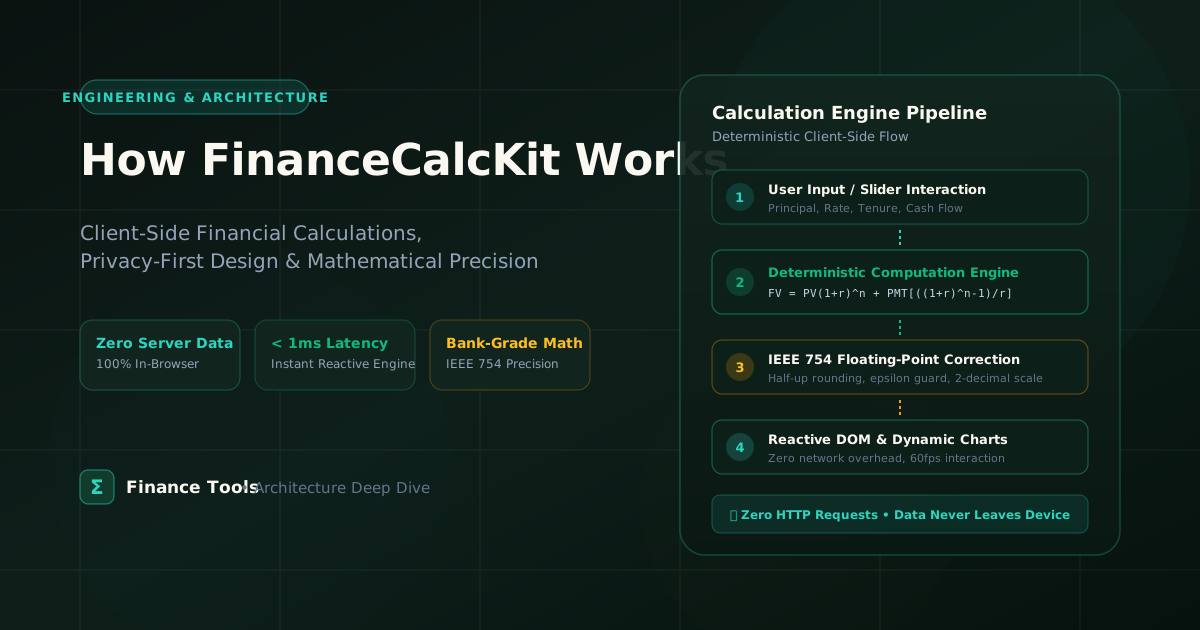
- Zero Server Data Transmission: Every financial formula, amortization table, and compounding curve executes 100% client-side in your web browser. Your confidential inputs (salary, loan balances, savings, net worth) never cross the network.
- Sub-Millisecond Reactive Engine: Built on modern React state management and pure algebraic functions, recalculations occur instantly (< 1ms) upon every keystroke or slider movement without server round trips.
- IEEE 754 Precision Safeguards: Calculations use floating-point epsilon guards and decimal scaling to prevent standard binary rounding errors (such as ), delivering exact banking-grade figures.
- Standardized Regulatory Math: All formulas adhere to recognized financial engineering standards, including CFPB Regulation Z truth-in-lending rules, FINRA compound interest conventions, and IRS annuity principles.
The Core Architecture: In-Browser Financial Computing
Most traditional financial web applications operate on a legacy server-rendered model: when you enter a loan amount or interest rate, the browser sends an HTTP POST request containing your private data to an external server. The server computes the numbers, formats a response, and transmits it back across the internet.
FinanceCalcKit was architected on an entirely different paradigm. We believe that personal financial planning should be instant, completely private, and mathematically verifiable. Every calculator on this platform runs entirely within your device browser runtime using modern JavaScript and TypeScript compiled via React.
No financial figures, income inputs, or debt balances are ever transmitted to our servers or saved in a remote database. All state resides exclusively in transient browser memory.
Eliminating network round trips means calculations execute in sub-millisecond timeframes (under 1ms), enabling continuous real-time graph updates as you drag input sliders.
The Mathematical Calculation Engine
At the heart of FinanceCalcKit is a library of deterministic mathematical functions rendered and validated using standard mathematical notation. Below are the primary mathematical derivations powering our most widely used financial instruments.
1. Time Value of Money (TVM) and Compound Growth
The future value of an investment combining an initial lump-sum principal and periodic recurring contributions (such as monthly SIP deposits) is derived using the generalized compound interest formula with an ordinary annuity:
Where = Future Value, = Present Value (initial deposit), = Periodic payment amount, = Periodic interest rate (), and = Total compounding periods ().
To test this formula interactively with custom periodic contributions and inflation adjustments, explore our compound interest calculator and SIP calculator.
2. Standard Loan & Mortgage Amortization
Fixed-rate installment loans (such as home mortgages, auto loans, and personal loans) determine the constant periodic installment () using the fixed annuity amortization formula:
Where = Loan principal, = Periodic monthly interest rate (), and = Total number of monthly installments ().
For complete principal vs interest breakdown tables across any mortgage schedule, you can use our dedicated mortgage calculator.
3. Effective Annual Rate (EAR / APY) Conversion
Because different financial products compound on varied schedules (daily, monthly, quarterly, or semi-annually), comparing them requires standardizing their nominal interest rate () into an Effective Annual Rate (EAR), also known as Annual Percentage Yield (APY):
For continuous compounding where compounding frequency approaches infinity (), the expression resolves through the natural exponential constant :
Similarly, the exact doubling time of an investment is derived from logarithmic compounding relations, which forms the mathematical basis for the Rule of 72 heuristic:
You can convert and compare nominal rates against actual yield using our effective interest rate calculator or evaluate basic non-compounding returns with the simple interest calculator.
Numerical Precision: Overcoming IEEE 754 Floating-Point Limitations
JavaScript natively represents numbers using 64-bit binary floating-point arithmetic compliant with the IEEE 754 standard. While exceptional for high-speed scientific computing, binary floating-point representation introduces small precision anomalies in base-10 financial math (for example, ).
In multi-year financial projections or 360-month mortgage schedules, unchecked floating-point drift can accumulate into noticeable multi-dollar rounding errors. FinanceCalcKit implements a multi-layer precision protocol to guarantee bank-level accuracy:
1. Integer Scaling & Cent-Based Arithmetic
Where applicable, monetary sums are scaled to integer cents () prior to performing addition and subtraction pipelines, completely avoiding base-2 binary fractional inaccuracies.
2. Machine Epsilon Guarding
When rounding calculated values to standard two-decimal currency precision, our engines apply JavaScript machine epsilon () to eliminate boundary floating inaccuracies:
3. Amortization Balance Reconciliation
In multi-period loan schedules, each period interest is calculated against the precise outstanding principal balance (), and the final payment automatically reconciles any odd cents so the ending balance reaches exactly .
Worked Numerical Walkthrough: The Evaluation Pipeline
Let us examine how the FinanceCalcKit engine processes a real-world calculation in real time. Consider a 30-year fixed home mortgage scenario with the following inputs:
- Principal Loan Amount (): $300,000.00
- Annual Interest Rate (): 6.60%
- Tenure (): 30 years ( monthly payments)
Architecture Comparison: Client-Side vs Server-Side vs Spreadsheets
How does FinanceCalcKit client-side engine compare with conventional cloud calculators and manual spreadsheets?
| Evaluation Metric | FinanceCalcKit (Client-Side) | Legacy Server Calculators | Spreadsheets (Excel/Sheets) |
|---|---|---|---|
| Data Privacy | 100% Private (Never leaves device) | Low (Transmitted via HTTP requests) | High if local, Low if cloud-hosted |
| Execution Latency | < 1 ms (Instant response) | 200 ms to 1,500 ms (Network lag) | < 10 ms (Local software) |
| Interactive Sliders | Smooth 60 FPS real-time updates | Sluggish, requires button clicks | Manual cell edits required |
| Offline Accessibility | Fully functional once page loads | Non-functional without internet | Supported on desktop apps |
| Visual Amortization Charts | Automated, interactive SVG graphs | Static server-generated images | Requires manual chart building |
When comparing loan offers from different lenders, always distinguish between the nominal interest rate and the Annual Percentage Rate (APR). The nominal rate determines your monthly EMI, but APR incorporates mandatory upfront fees, points, and closing charges to display the true economic cost of borrowing. For paycheck planning and take-home pay estimations, test scenarios on our salary calculator.